








Publications & Articles Scientifiques
37. MFU-4 as a Benchmark Molecular Sieve for Efficient CO₂/CH₄ Separation in Biogas Upgrading
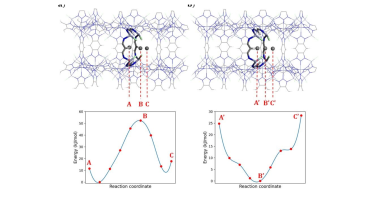
Abstract : Hydrogen is a clean energy carrier that supports low-carbon mobility and power generation and is widely used in oil refining and methanol production. Efficient separation of methane (CH4) from hydrogen (H2) is critical in the hydrogen supply chain, particularly for H2 purification after steam methane reforming and H2 recovery, etc...
URL of the article
36. Viable Metal–Organic Framework Adsorbents for Thermodynamics-Driven Methane/Hydrogen Separation
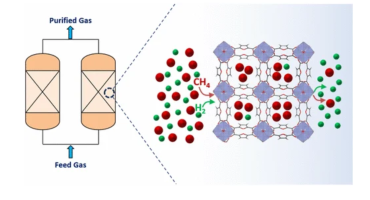
Abstract : Hydrogen is a clean energy carrier that supports low-carbon mobility and power generation and is widely used in oil refining and methanol production. Efficient separation of methane (CH4) from hydrogen (H2) is critical in the hydrogen supply chain, particularly for H2 purification after steam methane reforming and H2 recovery, etc....
URL of the article
35. Modeling Water and Carbon Dioxide Adsorption on Metal−Organic Frameworks with a Modified Equation of State: Application to CALF- 20, Al-Fumarate, and CAU-10‐H
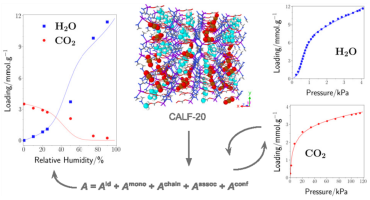
Abstract : Predicting adsorption equilibria for CO2 capture under humid conditions, both in flue-gas treatment and in direct air capture, is essential for process design. We therefore extend a confined-fluid equation of state (SAFT–VR Mie + CONF) to describe associative fluids adsorbed in metal–organic frameworks, etc...
URL of the article
34. Fundamental of CO2 Adsorption and Diffusion in Subnanoporous Materials: Application to CALF-20
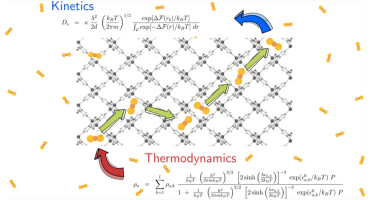
Abstract : We propose an approach for approximating the thermodynamics and kinetics of guest molecules in nanoporous materials. This statistical mechanics-based method requires a minimal set of parameters as input and has been applied to CO2 molecules, etc...
URL of the article
33. Mind the Gap: The Role of Mass Transfer in Shaped Nanoporous Adsorbents for Carbon Dioxide Capture

Abstract : Adsorptive separations by nanoporous materials are major industrial processes. The industrial importance of solid adsorbents is only expected to grow due to the increased focus on carbon dioxide capture technology and energy-efficient separations. To evaluate the performance of an adsorbent and design a separation process, the adsorption thermodynamics and kinetics must be known. However, etc...
URL of the article
32. Engineering of an Isoreticular Series of CALF-20 Metal−Organic Frameworks for CO2 Capture
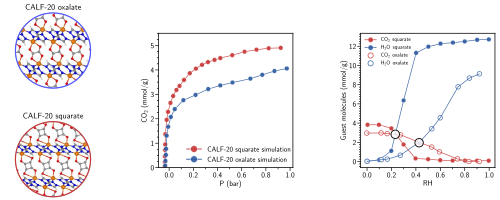
Abstract : A series of linker-substituted ultramicroporous CALF-20 metal−organic frameworks (MOFs) were built in silico, and their CO2 capture performances over N 2 in flue gas conditions were systematically computationally explored. Among the various linker substitutions explored, squarate-linker-incorporated CALF-20 (SquCALF-20) was demonstrated to show a larger CO 2 uptake at 0.15 bar (3.6 mmol/g) and higher etc...
URL of the article
31. Abnormal CO2 and H2O Diffusion in CALF-20(Zn) Metal-Organic Framework: Fundamental Understanding of CO2 Capture
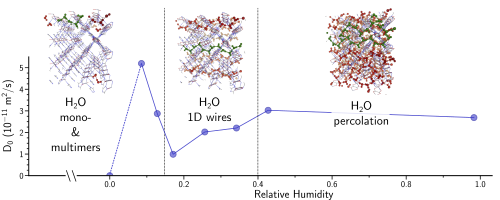 Abstract : Carbon mitigation is one challenging issue that the world is facing. To tackle
deleterious impacts of CO 2 , processes emerged, including chemisorption from amine
based solvents, and more recently physisorption in nanoporous solids. Physisorption
in Metal-Organic Frameworks (MOFs) is currently attracting a considerable attention,
however the selection of the optimum sorbent is still challenging. etc...
URL of the article
30. Trigger Smart Data Saving Applied to CO2 Capture in Metal-Organic Frameworks
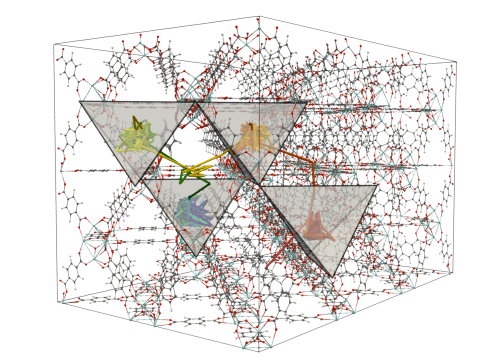 Abstract : Facing the need for carbon emission reduction, processes such as
CO2 capture in nanoporous Metal-Organic Frameworks (MOFs)
have emerged. However, such processes still need to be improved,
by understanding the dynamic properties of CO2 molecules when
confined in MOF nanopores. To do so, etc...
URL of the article
29. Modelling Carbon Capture on Metal-Organic Frameworks with Quantum Computing
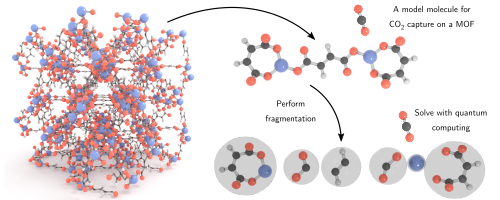 Abstract : Despite the recent progress in quantum computational algorithms for chemistry, there is a dearth of quantum computational simulations focused on material science applications, especially for the energy sector, etc...
Download article in pdf
URL of the article
28. Adsorption for CO2 capture: experimental focus on the thermodynamic and kinetic role of water
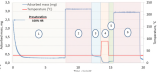 Abstract : A global energy transition based on low-carbon energy is urgently needed to limit greenhouse gas emissions and the
resulting global warming in the next decades. To tackle greenhouse gas effects, particularly CO2 contributing to 70%
of the overall emissions, drastic changes must be made...
URL of the article